Photography Archive

Artes Mundi 2010

This year’s Artes Mundi exhibition opened at the National Museum of Wales, Cardiff last month. Since it’s conception in 2003, the international Artes Mundi scheme (and award) has celebrated and exhibited contemporary New Media Art from a wide range of cultural backgrounds and countries. The idea amongst all, to connect Wales to a global modern art sphere.

This year’s overall theme was ‘Humanity’. Eight artists have been shortlisted for the award, all of whom are exhibited at the museum. The modern works include video installations/films, photography stills, lightbox images and ink drawings – with only one painting.

Highlights include Peru-born Fernando Bryce’s work, which looks at the ways in which print media reports and covers historical events. Bryce questions the perceptions of history and the construction of what we take as fact. He does so by imitating print media and through appropriation of newspapers and various prints. The images he produces are beautifully hand-drawn in ink, and challenge how we read and accept ‘facts’ in the media.

Chen Chieh-Jen uses film and photography to portray working labour, the social history and the working people who have been forgotten amidst growing consumerism. Chen’s stunning film ‘Factory’ is a beautifully shot piece, highlighting the plight of a factory in Thailand, now derelict; a victim of cheaper labour elsewhere. Amongst the ghostly rubble and machinery, he places former workers, silent in their protest at the way they were treated/sacked; forgotten workers, whose toil and mundane drudgery were unfairly ignored. Chen gives them a voice despite their silence, through slow moving camera-shots amongst the cob-webs, the melancholic death of an industry.

The poetic camera-angles of the aesthetic are a stark contrast to the decay of the topic, or indeed, the corruption in consumerism he wishes to portray.

Other exhibits include video installations and works dealing with issues in immigration, post industrialism, collapse of the Soviet Union and the deconstruction of Zionism. With artists from Albania, Peru, Russia and Kyrgyzstan amongst others, the Artes Mundi successfully brings world class art to Wales and illustrates New Media Art’s worth in expressing serious contemporary issues facing the world today.

The Artes Mundi exhibition runs at the National Museum of Wales, Cardiff until June 6th. The winner will be announced on May 19th.

Image by Sian Prescott – of Yael Bartana’s poster Manifesto, which visitors are encouraged to take home with them.
The Design Process Behind Classic Album Artwork

Storm Thorgerson is a British designer and artist responsible for more classic album covers than you can possibly imagine one person could create in a lifetime. From Pink Floyd to Audioslave, The Cranberries to Muse, he has produced the most compelling and memorable album artworks of the last 40 years.

An excellent exhibition of his artwork runs in the east-London Idea Generation Gallery from April 2nd to May 2nd, 2010. Part of the exhibition highlights his creative process for a specific case study. Check out the exhibition yourself to see the process in action and in detail. For now, here’s a quick overview:

  1. The Brief. The designer listens to the music (possibly only demos at this stage), reads the lyrics, and talks to the band. These create a ‘brain soup’, from which ideas can be extracted to form the brief.
  2. Roughs. Over a number of meetings/days, the designer meets the band again for discussions, in an attempt to pin-down a theme or big idea. This stage is creative, with word-play, honest thoughts, and scribblings. The best are converted to more complete illustrations (the ‘roughs’).
  3. Tests. Once a rough is accepted and a budget agreed, a prototype is often created to ensure that the idea works. Depending on the idea, this could involve the creation of scale models from clay or polystyrene. If everything works, the final models are constructed.
  4. Shoot. A location is researched and booked, possibly for a long-time if outdoors and in uncertain weather. Models are erected and positioned, with help from volunteers if the shoot is big and complex. A wide range of photographs are then taken, under varying light/weather conditions and filters.
  5. Editing. This could be called ‘selection’, where the best shot from the shoot is chosen. This can take several days, if hundreds of similar shots need to be compared.
  6. Artwork. Finally, having chosen the perfect shot, any cleaning-up or final computer editing is performed, before handing over the final product.

Written down like this, the process seems so simple. When you consider that some ideas involve 700 or 800 iron beds arranged on a beach with the tide approaching, you begin to appreciate that it might not be so simple after all.

London Shop Fronts

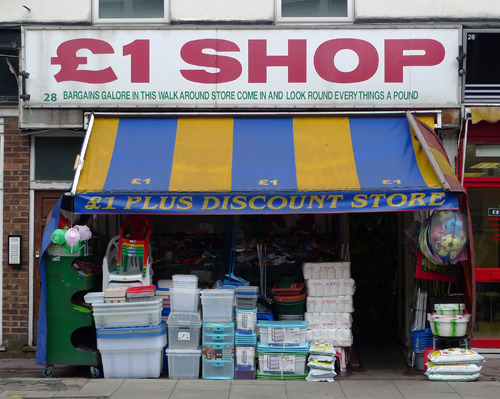
£1 Shop - Image by Emily Webber

Image by Emily Webber

London-based photographer Emily Webber has amassed a fascinating on-going portfolio of images of various shop fronts in London.

There is something so intriguing about these images, about the independent shops and businesses that are shown. So simple in concept, so layered under the surface. In a world which is dominated by big business and brands, the photographs seem to portray a dying world, a retro signed-existence that is too often forgotten or ignored. And like many urban photographical studies, it raises many questions about society. What does it tell us about our city life? What is the future for such a way of life? There’s chaos and grime, systematic of the city.

The collections are also a captivating look at various sign designs – graphics and typography, shop names from the random, to the ‘puntastic’, to the banal. From the american style to the classic italics. It’s like a life-size photoshop font collection of the present and yet also the past.

Beautiful. Melancholic. Urban. Dying. And yet, somehow, very much alive.

Image by Emily Webber. The London Shop Fronts web site.

I Was Going to Tell You About Ice Storms

130525951_b7a7116d39

In the spirit of the recent smattering of snow in London, I was going to tell you all about the great North American ice storm of 1998 and include some interesting facts about snow and ice. Like the difference between glaze ice and rime ice, the fact that a typical ice storm  is 50 km wide and 500 km long and a whole host of other things to pique your curiosity.

Then, while searching Flickr for Creative Commons images of ice storms for the post, I found what may be the best photo pool ever. As luck would have it, though not really relevant to my original intention, the photos are tagged ‘Ice Storm’.

You can view Rev. Xanatos Satanicos Bombasticos’s brilliant ‘ice storm’ photos here. Based on the notes, they are circa 1994.

Image Credit:  Vicky’s Clint-Calendar Ice-Storm 1994 photoshoot – 0158 Ice Storm – Clint behind icy fence 199402, by Rev. Xanatos Santanicos Bombastico.

Wisconsin Death Trip: Just In Time For Christmas?

Wisconsin2

When I was in my early twenties, an older friend leant me a book called Wisconsin Death Trip.  That particular copy was falling apart – the pages shuffled awkwardly against the spine – and seemed as old as its subject matter: a series of photographs taken between 1890-1910 by Charles Van Schaik, an American who learned photography after moving to Jackson County and thereafter spent fifty-seven years capturing small-town life in Black River Falls.

It sounds fairly dry, but the majority of the book concentrates on images of the deceased, which for some reason the good citizens of Black River Falls saw fit to dress and pose as though they were still alive.

The very idea sends chills down my spine, though the photos strike a peculiar balance between the macabre and the truly tragic (especially the portraits of young infants) which keeps you flipping through.

wisconsin1

To add another note of disconcertion to an already eerie discovery, the town that Van Schaik was in the midst of documenting was plagued by disease, madness, suicide, murder, addictions, business and farm failure, and an overall despair stemming from harsh living conditions – all of which seems to infiltrate even relatively innocent portraits.

The book itself, which was written in 1973 by Michael Lesy, has since been adapted into a film, which speaks volumes about the extensive resonance of this beautiful, ghostly text.

Images from Wisconsin Historical Society